Submitted to NeurIPS 2026
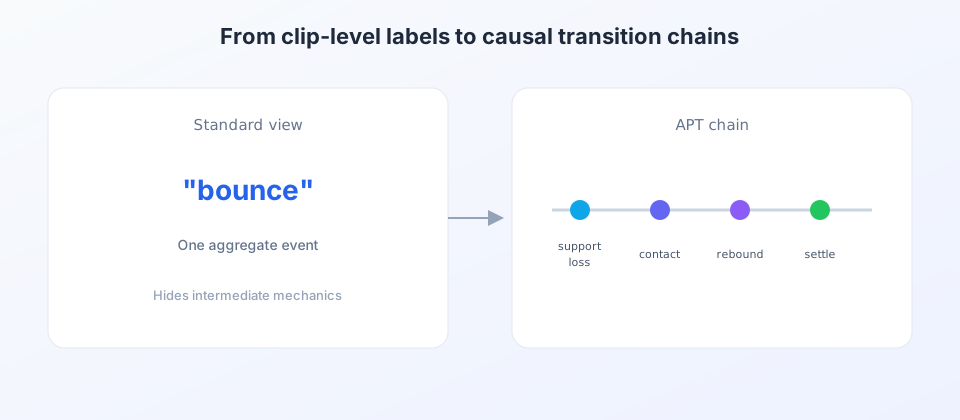
Physical events are not understood by their names alone, but by the causal state changes that compose them. A clip-level label such as “bounce” can be correct while hiding the process that makes the event physically valid, from support loss and contact onset to rebound and settling. We introduce Atomic Physical Transitions (APTs): minimal, temporally localized state changes that bind a visible cue to an active physical mechanism and a before/after dynamical regime. An APT chain represents a video as an ordered causal transition sequence rather than a single aggregate event label. We construct mixed-source APT data from human annotations and simulator ground truth, covering 14 transition types across contact, gravity, friction, and rotation/stability, with 27,303 timed instances over 1,246 trials. Current VLMs largely miss transition-level physics in zero-shot settings, while direct fine-tuning on APT chains can improve transition detection but cause event-level forgetting. We propose APT-Tune, a parameter-efficient recipe that combines image-pad-aware supervision, format-conditional co-training, and mechanism-conditioned domain-to-type decoding. With about 11M LoRA parameters on Qwen3-VL-2B, APT-Tune substantially improves APT recall while also improving event-level video transfer, supporting the view that APTs are a human-aligned causal supervision signal rather than merely a new answer format.
APTs operationalize physical video understanding as ordered, mechanism-typed state changes; APT-Tune makes this supervision reusable across ordinary video QA formats.
Each transition binds a visible cue to an active mechanism and a before/after dynamical regime, yielding typed timestamps that form an ordered chain.
Human labels on real video and datasets such as CLEVRER anchor semantics; Physion++ / TDW / Unity and Phys4D-style Isaac Sim provide scalable simulator evidence converted into the shared APT schema.
Pad-aware supervision, co-training across APT and non-APT formats, and mechanism-conditioned decoding reduce format overfitting and label memorization.
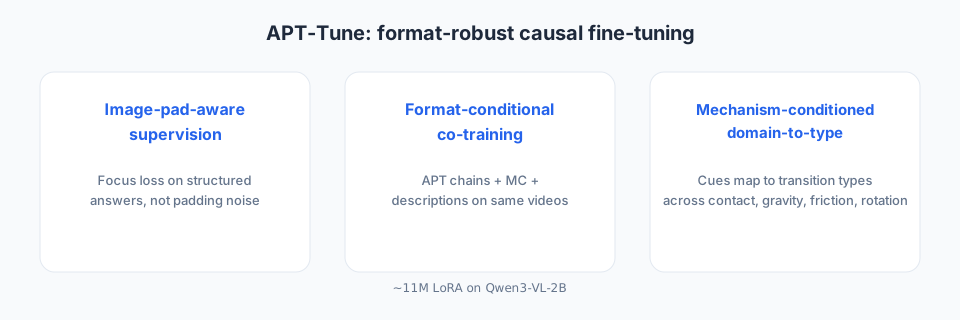
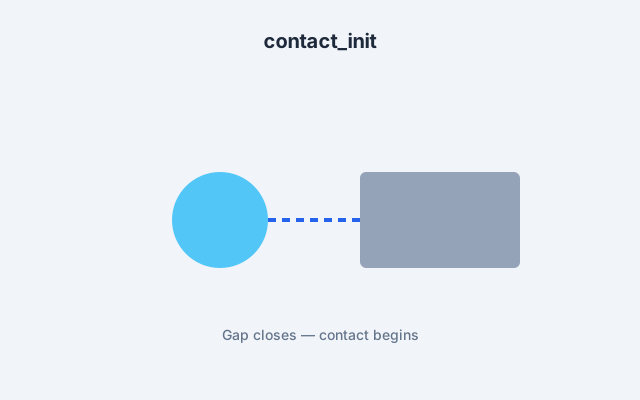
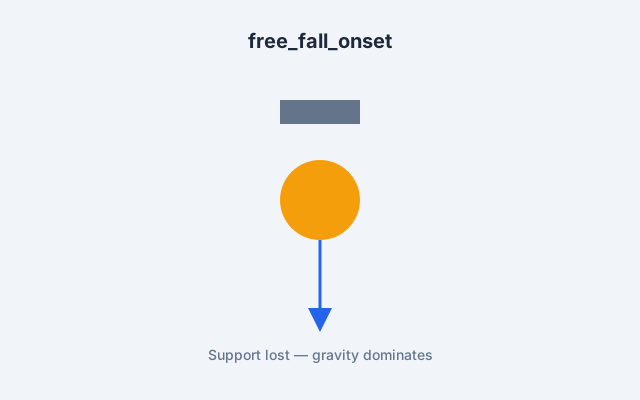
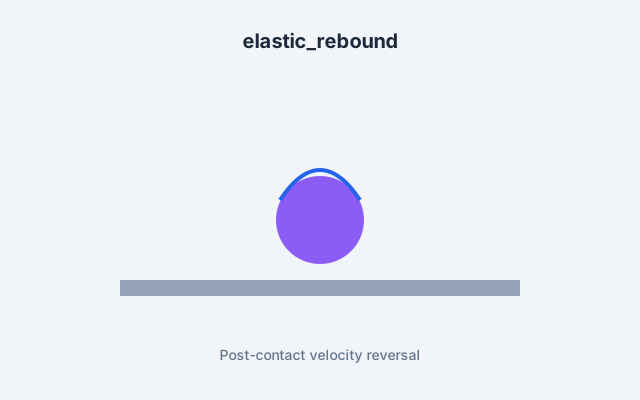
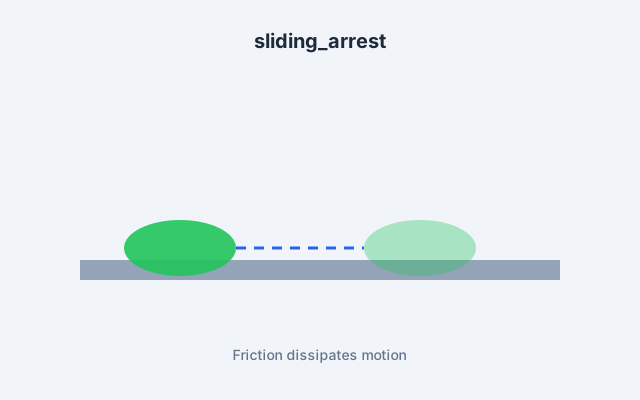
Illustrative schematics (not paper figures). The full taxonomy spans 14 types across contact, gravity, friction, and rotation/stability.
| Aspect | Typical physics / temporal benchmarks | APT (this work) |
|---|---|---|
| Unit of evaluation | Clip-level QA, endpoints, plausibility, trajectories | Timestamped, mechanism-typed transitions in an ordered chain |
| Temporal grounding | Often partial or event-level | Explicit transition times with 14-type taxonomy in 4 mechanism domains |
| Supervision signal | Outcomes and answers | Causal process structure between recognition and full simulation |
| Data provenance | Varies by benchmark | Human + simulator ground truth; 27.3K APTs over 1,246 trials (paper) |
Numbers follow the anonymous PDF; final tables and qualitative videos can replace this summary after acceptance.
@inproceedings{anonymous2026apt,
  title     = {APT: Atomic Physical Transitions for Causal Video-Language Understanding},
  author    = {Anonymous Authors},
  booktitle = {Submitted to NeurIPS},
  year      = {2026}
}